¶ Poker
Sit down at the poker dealer’s table and play cards for real gold against other players. The table runs four classic games: Texas Hold’em, Omaha, Five-Card Draw and Seven-Card Stud. Some dealers also host Sit & Go tournaments, where everyone pays the same entry and plays for a prize pool.
You’ll find the poker dealer at the long table inside the Cat’s Lair tavern in north-west Britain.
¶ How to start
Talk to the poker dealer and pick one of the options:
| Option | What it does |
|---|---|
| I’d like to sit down and play | Opens the buy-in window so you can take a seat |
| I’d like to play a Sit and Go tournament | Opens the tournament lobby (only at dealers that run tournaments) |
| Show me my table | Reopens your table window while you’re seated |
| I’d like to watch the table | Opens the table as a spectator |
| How do I play? | Opens the How to Play window |
| I’m done playing, cash me out | Stands you up and pays out your chips |
| Open my bank please. | Opens your bank box |
You can also say the dealer’s name followed by one of these words: join or play (sit down), watch, tournament or sng (tournament lobby), rules (how to play), and quit, leave or cash out (stand up).
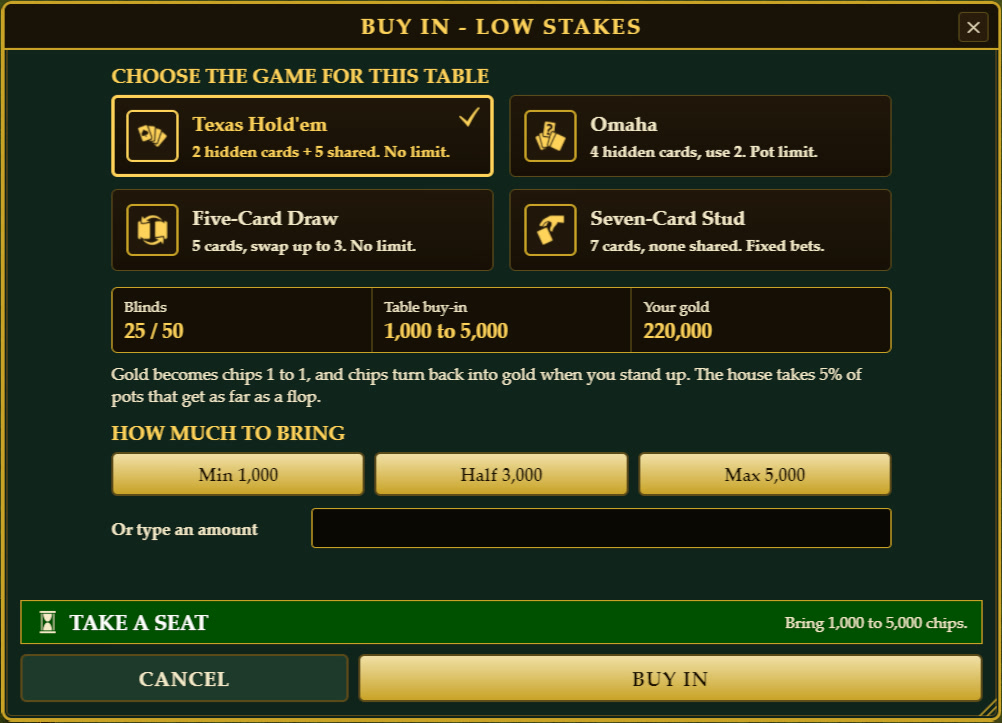
To sit down you must be alive, out of combat and close to the dealer. You can only hold one seat at a time, and only one character per account can play at a table. Each table has up to six seats. A dealer never runs a cash game and a tournament at the same time: while a Sit & Go is forming or running, nobody can sit down for cash, and some dealers run only tournaments.
Choosing the game: the first player to sit at an empty table picks one of the games that table offers. That choice stays locked while anyone is seated. When the table empties, the next player can pick again.
¶ How to play
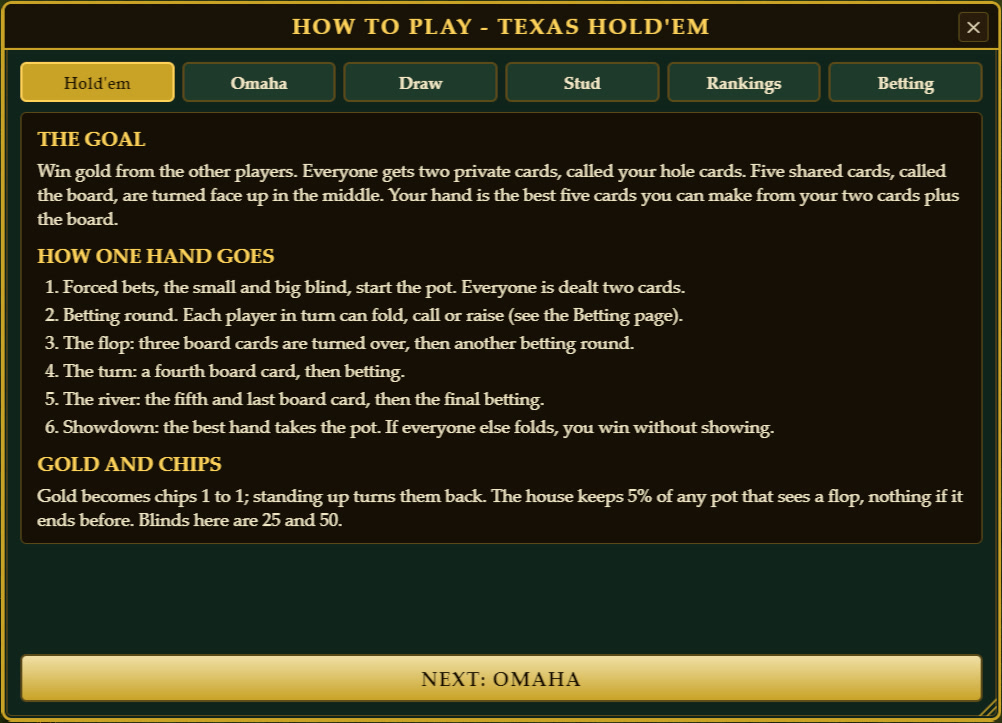
Every game uses the standard poker hand rankings, from best to worst: Royal Flush, Straight Flush, Four of a Kind, Full House, Flush, Straight, Three of a Kind, Two Pair, One Pair, High Card. A straight can be ace high or ace low. If two players have the same kind of hand, the higher cards win, and exactly equal hands split the pot. The How to Play window has a page with a picture of every hand.
¶ When it’s your turn
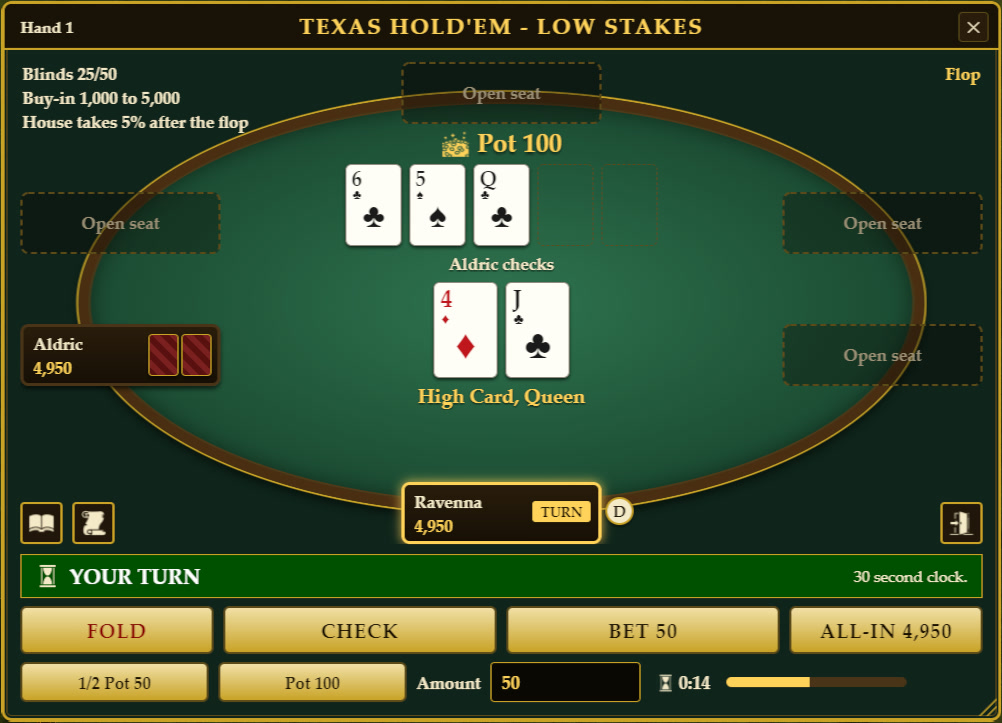
| Button | What it does |
|---|---|
| Fold | Throw your cards away and sit out the rest of the hand. You lose what you already put in, nothing more. |
| Check | Pass without betting. Only possible when nobody has bet this round. |
| Call | Match the current bet to stay in the hand. |
| Bet / Raise | Put in more than the current bet. “Raise to” means the total you’ll have in this round. |
| All-in | Bet every chip you have. You can only win from each opponent what they put in against you. |
You have 30 seconds per move. If time runs out, you check when you can, otherwise you fold (in Draw you stand pat, and in Stud the bring-in is posted for you). Run out of time twice in a row and you’re set to sitting out; press I’m Back to be dealt in again.
The D marks the dealer button. In Hold’em, Omaha and Draw the next two players post the small and big blind (with only two players, the button posts the small blind).
¶ Texas Hold’em (No-Limit)
You get two private cards, and five shared cards (the board) are turned up in the middle. Your hand is the best five cards you can make from your two cards plus the board.
- The small and big blind start the pot. Everyone is dealt two cards.
- Betting round.
- The flop: three board cards are turned over, then betting.
- The turn: a fourth board card, then betting.
- The river: the fifth board card, then the final betting.
- Showdown: the best hand takes the pot. If everyone else folds, you win without showing.
No-Limit means you can bet any amount up to your whole stack.
¶ Omaha (Pot-Limit)
Like Hold’em, but you get four private cards. Your hand must use exactly two of your four cards plus exactly three board cards. Four hearts on the board aren’t a flush unless two of your own cards are hearts.
The betting goes the same way as Hold’em (blinds, flop, turn, river, showdown). Omaha is pot-limit: the most you can raise to is about the size of the pot after you call. The Pot button fills in the biggest bet allowed, and All-in only shows when your stack fits inside the limit.
¶ Five-Card Draw (No-Limit)
Everyone gets five private cards and there are no shared cards. You get one chance to swap cards.
- The small and big blind start the pot. Everyone is dealt five cards.
- First betting round.
- The draw: starting left of the dealer button, each player clicks up to three cards to throw away, then presses Draw to get new ones. Press Stand Pat to keep all five.
- Second betting round, then showdown.
Other players can see how many cards you drew. If your time runs out on the draw, you stand pat.
¶ Seven-Card Stud (Fixed-Limit)
There are no shared cards and no blinds. Each player builds their own seven cards, some face down (only you see them) and some face up. The best five of your seven win.
- Everyone pays a small ante. You get two cards down and one up (third street).
- The lowest up card must open with a small forced bet, the bring-in, or may complete it to the full small bet. Folding instead still costs the bring-in.
- Fourth, fifth and sixth street: one more card face up each time, then betting. The best up cards act first.
- Seventh street: one last card face down, final betting, then showdown.
Bets have a fixed size: the small bet on 3rd and 4th street, double that on 5th, 6th and 7th. A round allows one bet and up to three raises.
¶ Stakes and fees
Each table has a stake level. The dealer tells you the stakes and buy-in when you talk to them.
| Stakes | Blinds | Stud ante / bring-in | Stud bets | Buy-in |
|---|---|---|---|---|
| Low | 25 / 50 | 5 / 12 | 50 / 100 | 1,000 to 5,000 gold |
| Medium | 250 / 500 | 50 / 125 | 500 / 1,000 | 10,000 to 50,000 gold |
| Rich | 2,500 / 5,000 | 500 / 1,250 | 5,000 / 10,000 | 100,000 to 500,000 gold |
- Gold becomes chips 1 to 1. The buy-in must come from one place: your backpack, your bank box, one bank check or your bank deposit balance.
- Re-buy: between hands you can top up your stack with the Re-buy button, as long as you stay within the table’s maximum buy-in.
- The house share: the house keeps 5% of a pot once it reaches a certain point: the flop in Hold’em and Omaha, the draw in Five-Card Draw, and fourth street in Seven-Card Stud. A pot that ends before that point is not charged.
¶ Winning and payouts
Pots you win go straight onto your chip stack. When you stand up, your chips turn back into gold, 1 to 1:
- If you’re online, the gold is placed in your bank box.
- Large amounts, or payouts while you’re offline, go to your bank deposit balance.
A system message tells you exactly how much you cashed out and where it went. The History button on the table shows the last hands played, with their pots and winners.
¶ Sit & Go tournaments
At dealers that host them, a Sit & Go is a small No-Limit Texas Hold’em tournament.
How it works:
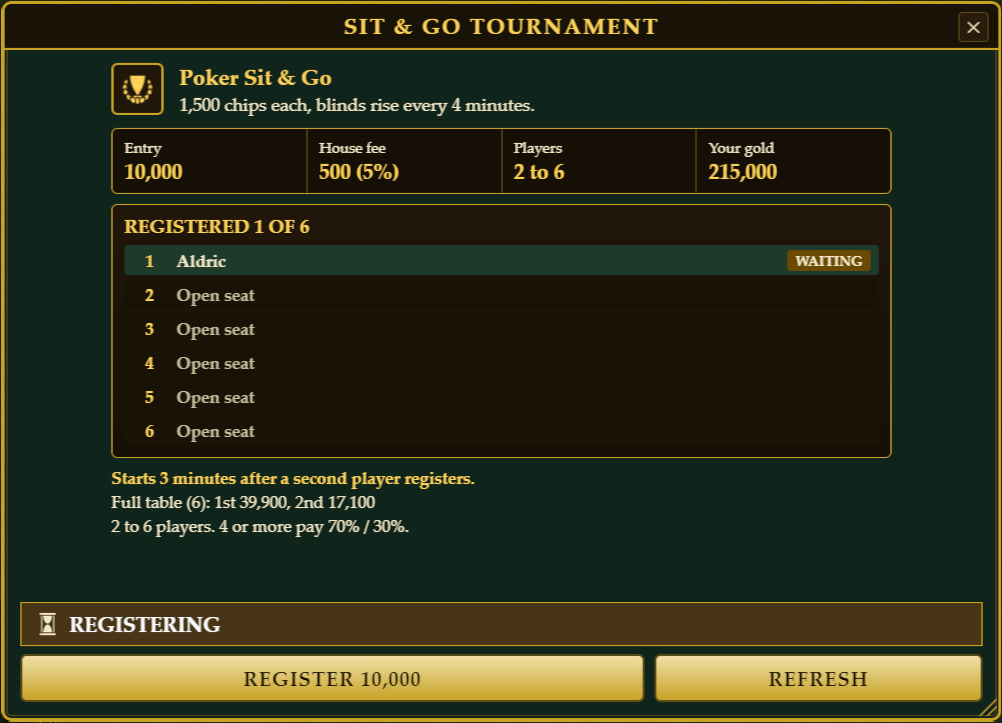
- The lobby shows the entry for that table (1,000, 10,000 or 100,000 gold), the house fee and who has registered. Press Register to pay the entry and take a seat. Your entry is held until the tournament ends.
- 2 to 6 players can enter. Only one character per account can play in a tournament.
- The tournament starts 3 minutes after a second player registers, sooner if everyone presses I’m Ready, and straight away when all six seats are filled.
- Everyone starts with 1,500 tournament chips. Tournament chips have no gold value.
- Blinds start at 10 / 20 and rise every 4 minutes (15/30, 25/50, 50/100, 75/150, 100/200 and so on). You have 20 seconds per move.
- Play continues until one player has all the chips.
- A tournament won’t start close to the daily server restart. The lobby shows how long the start is waiting.
Prizes:
- The house keeps a 5% fee from the pool of entries. The rest is the prize pool. The lobby shows the prizes for the players registered so far.
- With 2 or 3 players, the winner takes all.
- With 4 to 6 players, 1st place gets 70% and 2nd place gets 30%.
- If two players are knocked out in the same hand, the one who started that hand with more chips finishes higher.
- Prizes are paid into your bank deposit balance. The result window shows your place and your prize. If you’re knocked out, you can stay and watch the table.
Leaving a tournament:
- Before it starts, press Withdraw (or Stand Up) and your entry is refunded in full. Walking away from the table or logging out before the start also withdraws you with a full refund. Withdrawing over and over can stop you registering again for a short while.
- Once it’s running, Stand Up means resigning. You click it twice to confirm. Your chips stay on the table and are blinded off, so you can still finish in a paying place if others are knocked out first.
- If you disconnect or walk away, you stay dealt in: your hands are checked or folded for you and your chips are blinded off. Press I’m Back when you return.
- If every player but one has been away or sitting out for a short while, the tournament ends early: players still at the table finish ahead of those who left, and the rest are ranked by their chips.
¶ Good to know
- Standing up during a hand folds your cards, so the Stand Up button takes a second click to confirm. Saying quit, leave or cash out to the dealer folds right away. If you’re all-in, the hand plays out first. Either way, you’re paid out when the hand ends.
- Walking away: if you wander too far from the dealer or die, your hand is folded and you’re stood up and cashed out.
- Logging out while seated stands you up and cashes you out. Your gold goes to your bank deposit balance.
- Sitting out: if you sit out for 5 minutes, you’re stood up and cashed out.
- Out of chips: if your stack hits 0 and you don’t re-buy within 2 minutes, you’re stood up.
- Server restarts: a hand that’s in progress is cancelled and every bet goes back to its owner. Every seat is then cashed out to the bank deposit balance. A Sit & Go that’s forming or running is cancelled and every entry is refunded in full.
- New to poker? Watch a few hands first, fold weak hands, and play strong pairs and high cards.